Sunday, April 29, 2007

Leaving Ka'ata, Bolivia

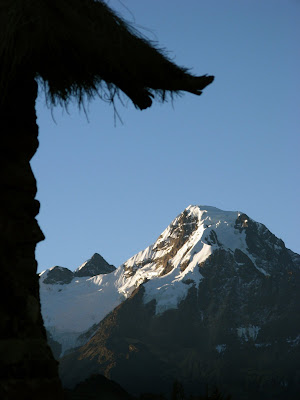
As Agapito left Ka’ata in the Apolobamba this time it felt like it could be the last time. He chipped the dirt from under his nails, peeled the sunscreen off his face and, stained green, he pulled the last coca stem from between his teeth. He shook the grain husks from his hair and noticed he smelled like dank donkey fur, powdered with adobe. His eyebrows furled a bit more than when he arrived and his skin was one crispy layer thicker. Looking down on Medicine Valley from the last pass before heading down to Charazani and the bus back to La Paz he had a last look at the Apolobamba Mountains and the terraces that drop from the glaciers like generational striations from the corn down by the river to the fava beans and then the potatoes at the top. He then realized that there really is no last time here.

Ka’ata moves with him as the burden and blessing of human existence. It is the dirt into which the holy breath has blown and brought about creation. Here is the tierra and the alma, the son and the holy ghost. This place can never leave because it is the very mesh in which we live. Each breath in Ka’ata is filled with the fundamental impulse to cut into the earth and allow her, Pachamama, to nourish while also granting that she devours just as much as she gives, no more and no less. It is the body before the mind or the mind giving way to the body, to being.

Agapito learned that donkeys carry a cross on its back, literally. Have a look, every donkey has a cross etched into the ratty matted coat on its back. Similarly, this valley carries the Christian cross on top of its pre-colonial cosmology just as the pre-Columbian Andean Cross has been altered to that of the crucifixion in most parts of the Andes. Here in Ka’ata the herding Kallawaya woman wraps a traditional weaving around her head and a felt hat over that while her healer husband carries a colorful pouch of medicinal herbs over his shoulder. Demons, achachilas and ordinary animals are woven into the fabric that they fold around the child as they harvest potatoes at the start of the Bolivian winter.

Ka’ata is both beautiful and tragic, the same as the world. The infant wrapped in the intricate weaving is more likely to die soon here than anywhere else on the continent. The communal enthusiasm that the village has for tilling, planting and harvesting each year is frequently met with the tragedy of insufficient harvest; and so growth, life and death are all woven into the collective memory as well as the perceptions of the present. Visiting Ka’ata is a reminder of this and a reminder that this reality has infused all creation. It is impossible to shake this fateful reality and for this there is no leaving Ka’ata.


Spring

Agapito woke the morning of March 22nd after a rainstorm and fell in love. He had never felt better. Thinking back on the day, there was nothing special. Sure, the buds were budding and the geese returning and as he walked through the back alley he noticed only one last pocket of snow persisting from the winter behind the compost pile. But it was the feeling that was different within him, even though his surroundings were exactly as they should be around the equinox. You know days that smell like love, that feel like love? As if someone slipped some wine in your morning tea and you walk around in a love-drunk blush, giggly and rosy-red, reaching down to touch the sidewalk just to know how it feels?

Agapito did just that; he ran his finger along a section of sidewalk to where it met the crease between that one and the next section. He found it to feel something like the interface between hope and reality, where hunger meets satiation and it felt a bit damp. He noticed there were buds even in the crease and it reminded him of the avocado tree growing from the compost that a friend once found and placed in his living room. It never gave fruit, being Colorado, but it grew to an impressive height considering it came from a compost pile. Tich Nhat Hanh, the renowned Vietnamese monk writes of roses and garbage and of the beauty found in both, not because of an argument of aesthetics such as garbage makes you appreciate the rose (which is also true) but because there is no inherent difference between the two, where one ends the other begins. And it is not about creating an illusory reality where no garbage exists, but about loving the reality around you and loving the garbage too, as it is. For this, Agapito fell in love that morning. As he ran his fingers along the crease he unveiled and undressed the beautiful eternal goddess with all of her mystery and saw her in every stranger he met that day.

His finger ran over half of the crease one last time before detouring onto a crack that split out the next section of concrete. As he traced the fault his finger ran into the resistance of partly painted toenails protruding from a pair of sandals. He tried to pass the obstacle, up over the toe, racing across the tendons of the feet and onto the ankle, wondering if he should continue up the curve to see where it would land when he realized his absent-minded stroking had made its way onto real nerve-endings and was now being felt by another. A girl was standing above these partly painted toenails, and she may have been standing for quite some time, from the curiosity etched on the edges of her smile. The feet were still pale, this being the first appropriate day for sandal of the year and her face had been touched by the early spring-sun, a tinge of rose on a white wintered-face. She was beautiful.

In the same way that his finger had been moving along the concrete and then onto her feet, his eyes now coursed her face, neck and down before slowly moving back to her face, where they remained transfixed for an embarrassingly long time. She giggled, “That tickled.”

Agapito had been on his knees and he rolled back to sit clutching his shins and look up at her from a better angle. She looked equally beautiful and continued to smile. “Have you been here long?”

She nodded and squatted down to his face-level. “What were you doing?” she whispered sarcastically, mocking the importance of the activity.

He was about to open his mouth and paused, reconsidering his response. “Well, I thought I was looking for something beautiful in the crease of this concrete, and I guess I was. I try to find it in difficult places and . . .”

“Why try so hard?” she asked. “Why be so dramatic?”

Agapito furled his eyebrows and thought for a minute, considering the question seriously while not realizing the irony in his reaction. His face looked dramatic, pensive.

She bent down and squatted with him at eye-level. “Why try so hard?” she repeated, this time dramatically.

Agapito felt the clutch of spring, the irresistible flow of intimacy and attraction and it moved through his body like smoke in sunlight – not quite dissolved but mysteriously and brilliantly dancing. He followed the sensation and asked, shifting his pitch, “Why are you so curious?”

“Because it seems important,” she laughed, “or at least fun, I can’t remember ever caressing concrete.”

“I don’t even know you and you’re making fun of me. It isn’t really important, do you want to try?”

“Yes,” and she bent down, pressing her pinky to the soil between two slabs of concrete. Her approach was much less defined. She followed the crack in the sidewalk to its edge and moved her exploration to the soil on its edge, pressing her fingers into the soil that sits below the slabs.

This is the art of romance, pressing between the creases, pursuing a curiosity that penetrates behind the piecemeal slabs of persona. It is the same curiosity of the spirit that guides any inspired sense of wonder, be it academic, spiritual or romantic. The trick with love is in allowing the other to do the same and Agapito wished he new in which areas to give way so that she could explore. But almost effortlessly this girl, in this marvelous spring encounter was beginning to probe the seldom-explored aspects of his being, the soil beneath the concrete, the underside of the sidewalk seeking both roses and garbage.

And this is the love of the spring, the possibility to see the world fresh and explore it as if for the first time in all its beauty and madness – the rapture of romance and the exaltation of beauty.

Monday, March 5, 2007

From the Austral Highway

One of the most intriguing parts of Patagonia, for me, is the Austral Highway, a narrow slice of dirt that cuts 100's of miles from the Valdivian rainforests and steep-sided fjords in the north to the open beech forests, massive lakes and wide glacier-carved valleys in the south. A seldom-traveled route took us from the Laguna del Desierto near Chalten, 31 kilometers north to Lago O' Higgins, across which starts the Austral Highway.

"Big Dream, Caution! One at a time." The imagination only supports one truly big dream at a time, I suppose?

Lago del Desierto, Argentina


Lago O' Higgins, Chile


Villa O' Higgins, Chile


Carretera Austral, Chile


Puerto Bertrand, Chile

Friday, March 2, 2007

Freeze and thaw

The Patagonian summer of 2007 was a timid one indeed, not really sure how to assert itself over the waning winter and so it didn’t. It sort of sat back and watched the winter keep its hold on the glaciers, on the forests where it continued to drop snow and on the skies where it kept away the summer’s sun. Summer tried a few times in January and actually punched through the crisp and cold curtain but only briefly before the winter’s wind kicked back in again and chased off any hopes for warmth or even thaw. This year winter came in and stuck. Agapito knew it was a large-scale shuffling of currents and tides, air temperatures and atmospheric composition – everybody knows that these days, especially in the south of the Southern Hemisphere where the ozone is badly in need of a bandage that is yet to be built by modern medicine. Although the hole in the ozone layer and greenhouse gas emissions are two separate entities, they are definitely two heads on the same monstrous body, two manifestations of the gross underestimation of the mesh-like nature of the world.

Agapito was tired of wondering about the hole in the ozone layer and imagined himself flying and poking around for a few days inside of it. He was climbing Osorno, a cylindrical volcano so nearly perfect you would think it were spinning on a potter’s wheel with some cosmic hands perpetually smoothing it’s contours. He walked dizzyingly up and around its flanks, lost in the continually perfect curve, when he noticed a speck of light above the summit. He first saw it as a star, but in realizing that no other stars were in the sky and that it was eleven in the morning, Agapito regained the focus and sense of awareness that he had lost in his conical course. About UFO’s Agapito had always been agnostic and about miracles increasingly accepting – he had seen his share of miracles but never a UFO.

Thinking back to encounters with people who claimed to have seen UFO’s he became even more skeptical, with each of the stories and personalities touched with lunacy. One such encounter was with a woman in San Cristobal de las Casas in Chiapas, Mexico from “Watts, Los Angeles” who spent two hours reciting a poem about blue-blood lines, Illuminati, terror and conspiracy, active human incinerators in the US and, ultimately, the battle between good and evil that is coming to a head. This is all tragic and probably true and eternally disappointing and overwhelming and it brought Agapito to tears with each new revelation about the struggle for light in these dark days, until the woman turned to Agapito and asked,

“Have you ever seen a UFO?”

He actually considered the question seriously for a moment before losing all interest in the conversation. She continued to tell the story of her first UFO sighting near her campsite by a mountain lake in New Mexico . . . and Agapito began thinking of how yummy the mango on a stick sprinkled with chili powder that the Mayan woman down the street was selling would be at that moment. Although she spent the next hour talking about the various UFO sightings she’d had, Agapito’s attention never strayed from his belly and how badly it wanted to be filled with mango and chili. His agnosticism about the matter was so chronic and debilitating to his attention span that he was never able to learn whether the ‘F’ in UFO stood for ‘flying’ or ‘floating’ and whether the ‘O’ was for ‘object’ or ‘obstacle’ or whether the whole abbreviation stands for “Un-objectified Feminine Object,” which is also a rare occurrence these days.

He came to again on Volcan Osorno with the celestial mystery still speckling the sky above the summit and his curiosity piqued by the recent absent-minded daydreaming about the woman in San Cristobal. Was this his first UFO sighting?

In the Ralun hot springs just south of the volcano, a few days prior, he actually had a conversation with a man about the relationship between the hole in the ozone layer and the presence of UFO’s in the area. Although Agapito’s attention at the moment was put toward how much better the hot-springs would feel if this man were not talking to him about UFO’s, he did manage to glean the theory that the ozone hole opens and closes depending on the size and quantity of objects that want to fly or float into the Earth’s atmosphere at any given time. Being that the hole is directly above this part of Patagonia, this man had seen countless UFO’s. Agapito remained a paralyzed agnostic on the matter and for that he only heard a few words of the man’s two-hour monologue, diligently maintaining that hot springs should be UFO-free zones.

So again, Agapito is on Volcan Osorno, staring up at the speck of light in the late-morning, full-daylight, full-azure sky, remembering these two conversations about UFO’s and wondering what the heaven he is looking at. He wanted to go back to ask Fitz Roy, who he suspected must have many similar encounters in this part of the world. But he was now over a thousand miles from the Fitz and was not sure when he would return. As he closed his eyes he began to think of another woman who had left the US to live in Costa Rica because her communication with extra-terrestrials who were involved in controlling world economics and were going to implement universal-debt relief and forgiveness, including debts to credit card companies and “third world debt to the first world,” was less impeded in the tropics than in the US because the US is full of mind-control devices and . . .

He began to journey.

A sombrero began to form on the volcano, which is like a lenticular cloud that forms when ice-crystals consolidate from cold air and high winds. The sombrero that forms on Osorno is a curious thing in the way it forms a large shade-giving brim, a perfect disk that looks like a 10,000 gallon Mexican hat when viewed from afar although the sterile white color of the thing is not quite as spicy as its typical Mexican counterpart. The sombrero does not move in from the west as many clouds do, rather it forms out of thin air, manifesting from the moisture in the air that is affected by the wind and cold, and “poof,” there it is! It spins in a perfect circle as well, like a record player spinning vinyl. As Agapito began to drift, he found himself spinning on the sombrero, standing on ice crystals and rising toward the speck in the sky. Surfing on his ice saucer he neared the light and as it expanded he began to see that although it displayed a brilliant light, this object was actually refracting the sun’s rays and was a thick floating chunk of ice.


The ice was spinning, and was shaped like a diamond, colder than ice at the bottom of a glacier and as hard as glass. Agapito imagined it to be a large chunk of Ice 9, from Vonnegut’s Cat’s Cradle, which can instantly freeze any water it comes in contact with, because of its extraordinarily high freezing temperature. Agapito was suddenly very cold and realized that he had been cold for months now. He was glad to know at least that this speck was not a UFO (unless that stands for ‘Unidentified Frozen Object”), so he could remain agnostic about the existence of extra-terrestrials. Circling the ice, he wondered about our future existence and whether the Earth would get warmer or colder or both, whether the ice was coming or going and for how much longer; he was somehow mystified to find himself alive at such an exciting time in history.

Everything happening these days seems to be the most important to have ever happened in the world – at least as far as human existence goes. But then he thought about the countless other high civilizations that may have come and gone even before the Egyptians and Chinese and Greeks and Mayans and Romans and the infinite others that could exist throughout the universe, and realized that the play here on earth was small beans indeed – so small yet so important and worth caring passionately about while also worth realizing how relatively microscopic the beans we’re playing with are. But this is different, isn’t it? This is new in history, a world completely connected, all the world’s cultures able to communicate and travel? This time the Apocalypse could be for real, right? Maybe so.

He knew what the ice was all about, he knew it was about to spread itself completely over the southern hemisphere’s summer and that winter was now here to stay. It didn’t bother him as much as it could have yet he began to cry tears that froze immediately to his cheeks. Could he live in such a cold world? Could the ingenuity of humanity thaw out such a cold world? Maybe so.

Circling on his saucer he knew he would not find those answers talking to a hunk of ice in the stratosphere and began to descend back to the volcano. As he neared the volcano, the sombrero on which he was flying began to circle rapidly around the summit and he was tossed off his stance, finding himself laying on his back on the summit ice-cap looking up at the same blue sky. The speck was gone and he was shivering on the cold ice, eager to return to town for a cup of coffee and an empanada.

The following day Agapito was on a bus toward the coast in central Chile, eager to catch a moment in the sun. His headphones were on and Modest Mouse was playing something off The Moon and Antarctica that goes like,

“So
long
to this
cold,
cold
part of the world . . .”

La Chocolateria de Chalten

In Chalten there is a chocolate shop where magic is crafted into obscenely delicious delicacies voraciously consumed by wind-weary travelers and climbers revolving around Fitz Roy or Cerro Torre. Like Water for Chocolate could be a good book or movie as a starting point for understanding this place, the romance of Patagonia and the desires of all Patagonian adventurers mixed into the uniquely Native American and ubiquitously sensuous smack of cocoa, the food of the Gods. Sure, chocolate is a far cry from the Xocolatl of Mesoamerica, a far cry from the food that “Mr. Chocolate,” one of Mayan Tikal’s great kings ceremoniously consumed, but the way the bean moves into our hidden passion-pipes has been the same for millennia. These days you can buy chocolate advertised not only as a giving elevation to your libido, but also packs antioxidants and other goodies with a force that muscles away pomegranates and spinach – chocolate as a dietary supplement. Fine by me.

And here at the Chocolateria of Chalten, in one of the original log cabins of this frontier town, they know how to make chocolate with a rustic, rugged, Patagonian twist. Cakes and crumbles, bars, stacked cookies and liqueur: what is most impressive about the place is not necessarily the sweetness of the treats or the view the mountains from the log-loft, or the fact that it is the most ambient place in the end of the world, but the fact that the food moves you and is moved by those that make it here. When thinking of Patagonia, some would think of leather and big skies, some of jagged mountains and maté, dirt and longing, contrast and culmination, condors and sheep, wind and water – I still think of those things as well as La Chocolateria here in Chalten. It’s magical.

Wednesday, January 24, 2007

Summit


A summit, a climax, a gathering toward something definitive, from this point you can travel no further unless you change the medium through which you are traveling, from the summit of a peak, if you want to continue moving in the same element you must go down – sure, we are capable of continuing up but we need wings, we need wind, we need tools that we have not used to get us this far: a summit is a culmination, all paths converging in this one element to come to a point, and in writing a period is a summit and since this piece has overtones of punctuation as defined by a mountain summit, periods are not included, have been shunned, it has been decided that the real summits about which are being spoken are more potent than the periodical summits of punctuation in writing and that this piece, for those reasons, is not broken by periods, but by the rolling waves of commas, the direct arrows of dashes – and the doorways of colons: not that this is unique in writing, I’m doing nothing new, Kerouac and Hemingway paved the way, many others before them of whom I’m not aware, just as earlier climbers have paved the way to the mountain summits around these parts of Patagonia, many of these people connected in text by hyphens: Terray-Magnone, Comaseña-Fonrouge, Kearney-Knight, etc. . . ah the ellipsis, the staccato “b-b-but wait there’s more” of the ellipses but I'm speaking no more of this because really this piece is not about punctuation but about summits, the way they collect the mass below them and bring it to definition, like the Earth Summits, collecting the mass of the environmental movement and defining it and in the same way a mountain summit, such as that of Fitz Roy bring the rocky mass of the peak to definition, the clearest, most concise way of saying, “This is who I am,” and so it is toward that definition that seekers seek, arrows point, mountains rise, summits entail this and on that unique point of Fitz Roy, the aspect that holds not a single nook of protection from the relentless winds off the Southern Patagonian Icecap, something poignant is pushing at your feet, with the mass of this mountain aiming up at that point on which you stand, and you feel something quite definitive.

Thursday, January 18, 2007

Nice to meet you, Mr. Fitz Roy

Agapito’s first conversation with Fitz Roy was a troubling one indeed. He had journeyed a tireless journey and found himself face-face with a living legend, a mountain deity of such impressive power and wisdom tucked in the mountains of Patagonia at the end of the world. Climbing three vertical kilometers he grew tired of the noise of the incessant wind, the cold and all the harsh elements so he began to verbalize some of his frustrations and his questions. The conversation was stopped short, as most are with Fitz, but he got answers to some of the questions he was looking for, but for every answer a dozen new questions popped into his head, leaving Agapito craving more conversations. Fitz has a way of throwing a fit when he is perturbed (thinking long and hard about the role of the masculine and feminine in this world, it has been decided that Fitz Roy is most definitely masculine, not just for his shape but also for his character), with patience in short reserve and Agapito found him on a no nonsense kind of day with a fit that chased him out of sight.

As the wind began to pick up and precipitation of all forms began to whip into Agapito’s head-to-toe Gore-Tex, Agapito commented, “You know, Fitz, you really carry a bad attitude. One-love, you know, go talk to your brother Jah, we're all one and you don't need to throw such a harsh front around. I mean, you could be more sociable, put on a party shirt and invite some folks up there sometime, knock off all that noisy music you always play, chill a little and put on something a bit more ambient. I mean, you don’t always have to be so hard, you know? Well, you are a big chunk of rock, so you’re inherently hard and I’m definitely not one to change someone or something’s inherent qualities, but . . .”

“You think this is funny, that I should have a sense of humor? When the whole world is laughing at something they don’t even know what, you think I should have a sense of humor? You don’t come up here with your party shirt and I don’t ‘chill’ as you say. I’m here as a reminder that while everything has a time and place, some things are meant to be hard, a lesson long since forgotten in your country. I’m here to be the biggest mirror you’ve ever had thrown in front of your face and you will have a glimpse of what you and all things are made of. If I were soft you’d have nothing for this to bounce off.

"If I didn’t exist as a constant and defined boundary you’d have no boundaries to test. You and the rest of your poets, comedians and artists would continue laughing at the world and pretend that there is always something funny in it. While humor can be found in the most unlikely of places, I allow none of it here, so again, leave your party shirt and your ambient music at home. Here I howl and shriek and scream and make sure anyone who comes near hears it. When I stop it is because I’m yawning and bored with the games played below at my feet.”


“But everything has it’s contradictions and juxtapositions, even in darkness I can find some light and all extremes are contained within the whole, nothing in this world is truly . . .”

“Except for me, and a few other things, like mortality and birth, a sip of water and a breath. These things are defined, clear and crisp boundaries, with no room for questioning their value or their quality. They truly are as they appear. True, life is contradictory, apparently polarized and myriad in its manifestations. Two poles exist, as exemplified by the feminine and masculine, dark and light, and within this are infinite colors. I do not exist in that middle, though, but rather am the most vacant darkness and the most blinding light, but nothing in between. It is in between these two that you are allowed to dance and laugh, talk about contradictions and wear a party shirt, but on either extreme you must come prepared, serene, humble and with no sense of humor. Come with embrace, for sure; come without attachment. You can even enjoy yourself in the moment on these extremes, but give yourself AND ME more respect than to laugh - not here. Laugh at the memory of this moment, laugh at other coming into similar situations, but do not laugh when you and I are intimately engaged as we are right now.” As Fitz Roy roared this last sentence, Agapito hunched behind a rock and gripped tight at the rope he was tied to.

“Can I ever get any of your respect and maybe be here with you comfortably, you know, friendly and such?”

“Agapito, it seems you are always trying to gain other’s respect, this is not about that. You can never gain my respect and you shouldn't try. I am not here for that and you are not here because you need it. You are here to learn and I am giving you a great lesson simply by existing as my rock-hard self. True, I cannot teach you how to laugh, nor to dance. I’m a rock for Christ’s sake; I sit here. Lightheartedness is not in my nature. Nor do I care whether you or a million others attempt to learn my weaknesses and climb through them. I am a rock, a mountain and my quality is to endure and to watch. That is the lesson you can learn and I’ll teach you if you are a willing student . . .”

“I am, I’m willing to learn anything you . . .”

“Oh stop, eagerness doesn’t make a good student, patience, humility and observation do. I know you have those qualities, and urge you to focus on them, sharpen them. You will, I know you will, and I’ll talk to you again when you have. Chao Agapito.”

And with a gust and a shriek that took the “But wait . . .” right out of Agapito’s throat and sounded as if it had ripped the neighboring spire of Poincenot in half, Fitz Roy sent him sliding down the mountain one rappel-rope after another, leaving his flanks to the ice and rain and the solitude he has created for himself. Agapito went to rejuvenate and await another chance to converse with the Fitz.